
About this Room
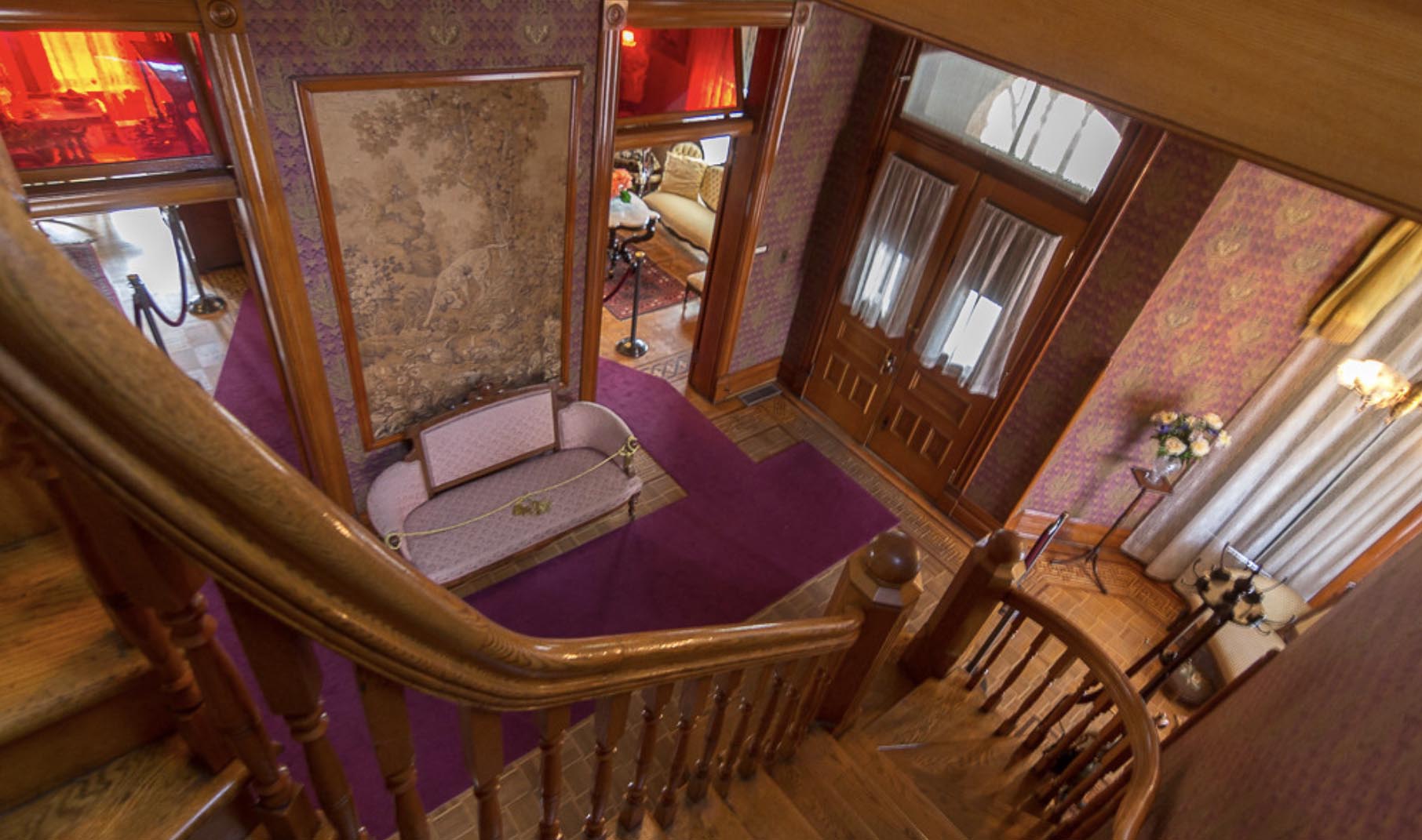
In the late 19th century, the entryway was a formal, elegant area in the home where visitors were received. From interviews with former residents of Rosson House, we know that there was once a multi-colored, Venetian glass chandelier lighting the home’s foyer, and that Jessie Howe Higley hosted afternoon tea for her friends in the turret area there.
The Rossons used architect A.P. Petit to work on the design of the home, which the Arizona Republican newspaper thought would be “one of the handsomest buildings in the city.” Though the bricks and upstairs flooring were likely made right here in Arizona, most of the materials used in building the house was sourced from the many trade catalogs available during that time, including the parquet flooring, wallpaper, windows and doors, cresting and turret finial, ceilings, and both staircases.
Find out more about some of the artifacts in the foyer by clicking the arrows on the top left above each image. Don’t see your favorite artifact here? Let us know you’d like to learn more about something by filling out this form.
Baby Carriage
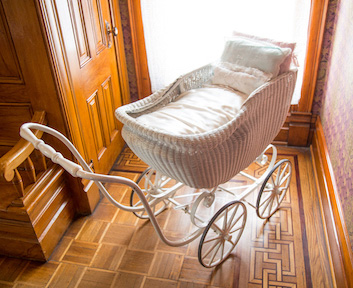
Baby carriage or perambulator with a wicker basket that is painted white, a leather flap inside that raises up to tilt the occupant, and a foot-operated brake. This baby carriage belonged to the Goldberg family and was used for their son, Chet Goldberg, who was born at Rosson House in 1899. The carriage had major repairs in 1986.
Flue Cover
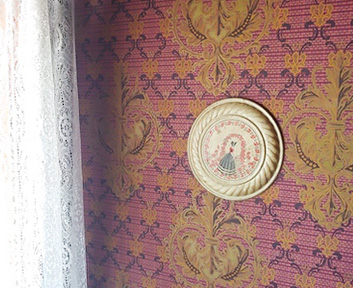 Round metal flue cover (early to mid 20th century), painted white with a decoration at the center. Before central heating, heat was produced by fireplaces or stoves and distributed into other rooms using pipes or flues. Often the pipe or flue opening in the wall was hidden by a decorative plate that doubled as a piece of art, which was removed when the fireplace was in use. The flue here is connected to the chimney for the family parlor fireplace.
Stairway Niche
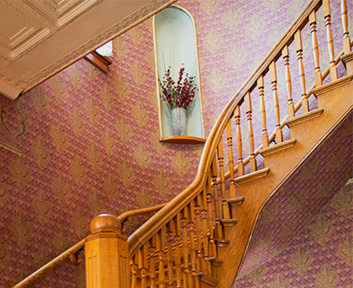 The niche was discovered by accident during restoration when a workman was running a screwdriver along the staircase wall. He noticed a different sound as the wall curved, and poked the wall, discovering the niche, It was original to the home, but had been bricked up and wallpapered over early in the home’s history.
Tapestry
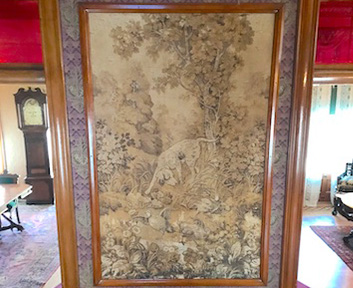 Jessie Jean (Higley) Lane asserts that this tapestry was bought by S.W. Higley around 1890 at the Chicago World’s Fair (which was in 1893), or possibly at the St. Louis Louisiana Purchase Exposition in 1904. The tapestry was on display in Rosson House when it was purchased by the City of Phoenix in the 1970s, and was stabilized by a conservator 1994.
Transom Windows
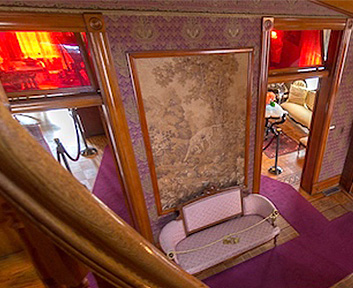 Made to allow the flow of light and air throughout a building, transom windows (or windows installed above doors) were very popular in Victorian architecture. The ruby glass transoms over the parlor door to the foyer and the dining room door to the foyer are original to Rosson House, though they were covered over for privacy for the lodgers who lived in those rooms. Ruby glass was unique because mixing gold oxide in the glass created the red color, making it more expensive.
1
2
3
4
5
6
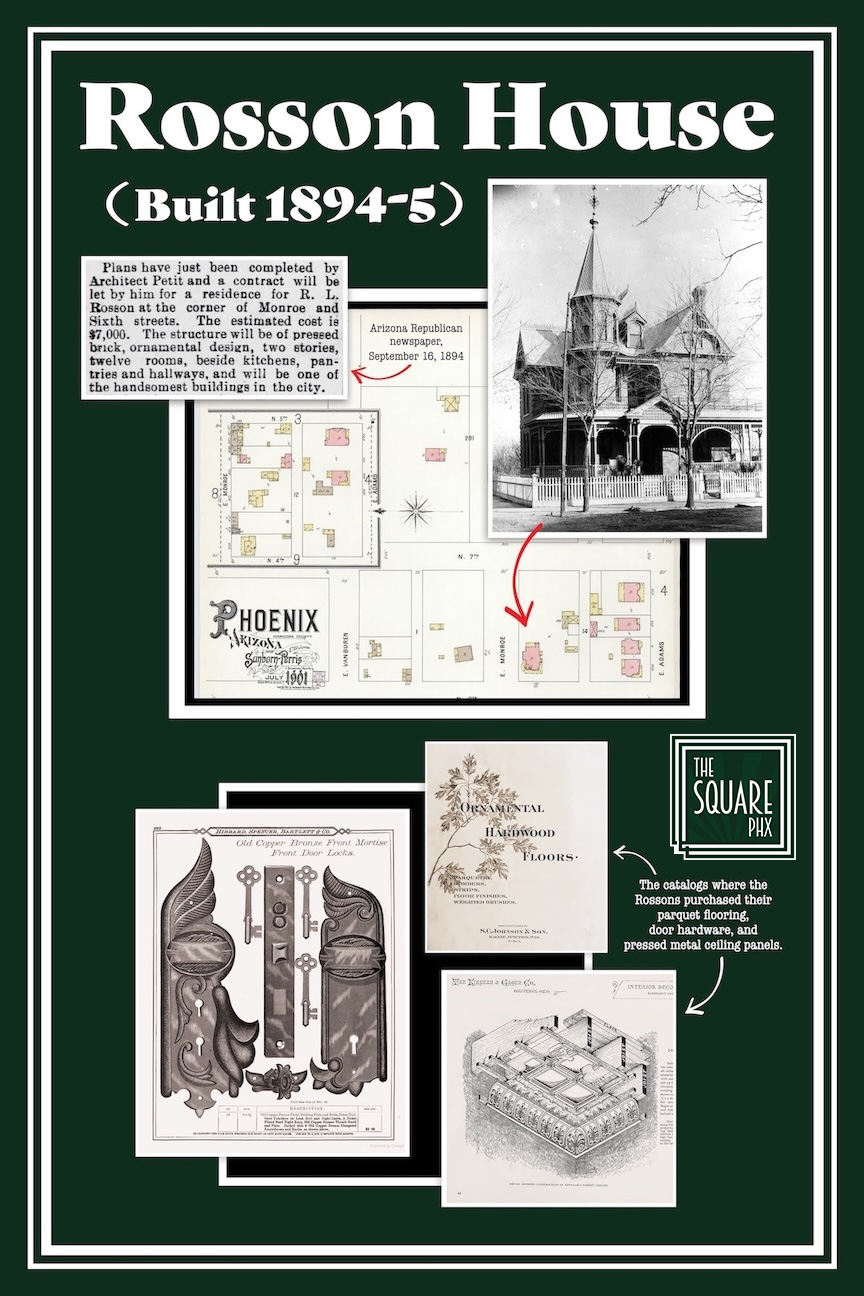
Exhibit Signage
Rosson House (built 1894-5)
- An article about Rossons’ plan to build an ornate new home, from the Arizona Republican newspaper on September 16, 1894.
- The location of Rosson House on the 1901 Sanborn Fire Insurance Map.
- Photograph of Rosson House, circa 1899.
- Page from the 1891 Hibbard, Spencer, Bartlett & Co. catalog, showing the door hardware used in Rosson House.
- Cover page of the 1901 Johnson Wax Co. catalog, which contains the parquet flooring patterns used in Rosson House.
- Page from the 1890 Kinnear & Gager Co. catalog, showing one of the pressed metal ceilings used in Rosson House.
1
2
3
4
5
6
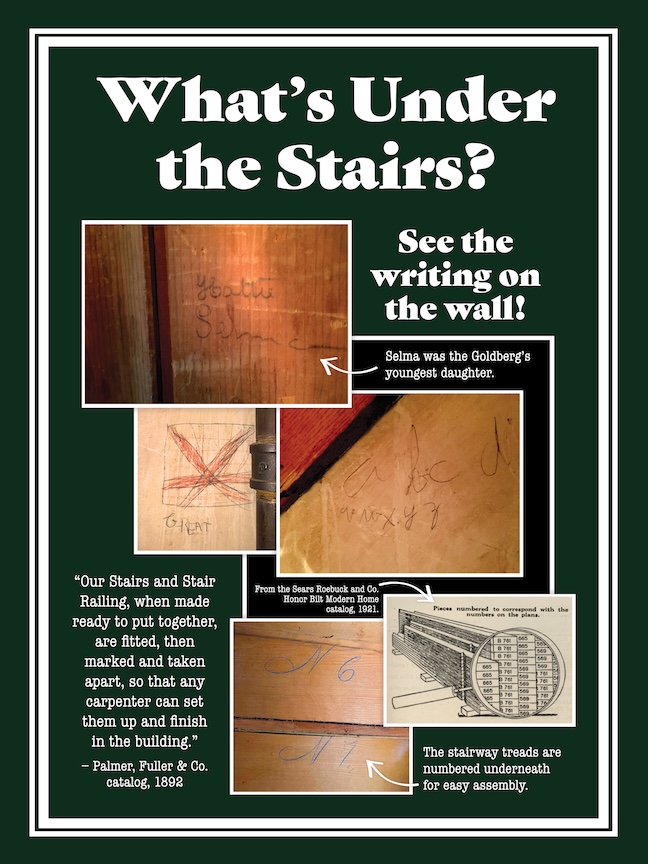
Exhibit Signage
What’s under the stairs?
- Photograph of the names Selma and Hattie, found in the closet under the main staircase at Rosson House. Selma was Carrie and Aaron Goldberg’s youngest daughter.
- Photograph of a drawing of the flag of Great Britain, found in the closet under the main staircase at Rosson House.
- Photograph of the ABCs, written across the entire north wall of the closet under the main staircase at Rosson House.
- Quote from the 1892 Palmer, Fuller and Co. catalog, about how they mark their stairs and stair railings for ease of installation.
- Photograph of the under side of the main staircase at Rosson House, showing the marks made by the company who made the staircase before shipping it to Phoenix.
- Page from the 1921 Honor Bilt Modern Homes (Sears Roebuck) catalog, showing the marks they used on materials for their catalog homes, made for ease of installation.

Connect with Us


Partners
Thank you to these local organizations for their grants supporting our organization.